Startups run on limited time, limited money and a long list of things that need to happen now. You might need a landing page this week, a pitch deck next month and a working product before your runway gets short. Hiring full-time staff for every one of those needs is slow, expensive and often unnecessary at an early stage.
That is why so many founders choose to hire freelancers for startup projects. Freelancers let you bring in the exact skills you need, for as long as you need them, without the commitment of a permanent salary. Done well, it can help you move faster and stay lean. Done poorly, it can drain your budget and leave you with half-finished work.
In this guide, we will cover when freelancers make sense for a startup, which roles they suit best and a step-by-step process for finding and managing the right people.
Why Startups Turn to Freelancers
Early-stage companies face a unique mix of pressure and uncertainty. Priorities change quickly, budgets are tight and the skills you need this quarter may not be the skills you need next quarter. Startup freelancers fit that reality well.
Key benefits include:
- Lower fixed costs — you pay for the work delivered rather than ongoing salaries, benefits and office space.
- Speed — an experienced freelancer can often start within days, compared with weeks or months for a full-time hire.
- Access to specialist skills — you can bring in a senior designer, developer or marketer for a specific project without hiring them permanently.
- Flexibility — you can scale work up or down as funding, priorities and product direction change.
- Room to test — working with freelancers helps you learn which roles you actually need before you commit to full-time startup hiring.
When Should a Startup Hire Freelancers?
Freelancers are not the answer to every staffing question, but they are a strong fit in many common startup situations:
- Building a minimum viable product (MVP) or prototype.
- Launching a website, landing page or brand identity.
- Creating pitch decks, financial models or investor materials.
- Running short marketing campaigns or content projects.
- Covering a skills gap while you search for a permanent hire.
- Handling specialist tasks such as security reviews, legal documentation or data analysis.
Core, long-term functions that shape your company culture and hold critical knowledge, such as product leadership, are usually better suited to founders or full-time team members. Many startups use a blend: a small core team supported by trusted freelancers.
Startup Roles That Work Well With Freelancers
Almost any skill can be freelanced, but some roles are especially common in a freelance startup team:
- Developers — web, mobile and backend developers for building and maintaining products.
- Designers — UI/UX, brand and graphic designers for product interfaces and marketing assets.
- Marketers — SEO specialists, paid ads managers, social media managers and content strategists.
- Writers — copywriters, content writers and technical writers for websites, blogs and documentation.
- Finance and operations support — bookkeepers, financial modellers and virtual assistants.
How to Hire Freelancers for Startups: 7 Steps
1. Prioritize What You Need First
Startups often want to do everything at once. Good startup hiring starts with focus, so before you hire, decide which project will create the most value right now. Is it shipping the MVP, getting your first customers or preparing for a funding round?
Hiring around your most urgent goal keeps your budget focused and stops you from spreading resources too thin.
2. Define the Scope and Outcome
A clear scope protects your budget and your timeline. Describe what needs to be delivered, when it is due, which tools are involved and what “done” looks like. For startups, it also helps to explain where the project fits in your bigger plan, so the freelancer understands the context behind your decisions.
A well-written brief attracts more serious candidates. Our guide on how to write freelance job descriptions that attract top talent walks through what to include.
3. Set a Realistic Budget
Every startup wants to save money, but setting a budget far below market rates usually leads to weak proposals and rework. Research typical rates for the skill, decide whether hourly or fixed-price pricing suits the project and set a range rather than a single figure.
If you need help planning costs, read our guide on how much you should budget for a freelance project.
4. Look for Startup Experience
Startup freelancers who have worked with early-stage companies before tend to be comfortable with changing priorities, tight deadlines and incomplete information. When you review profiles, look for past work with startups, an ability to work independently and a practical, results-focused mindset.
Their portfolio should show relevant work that solved real business problems. Our guide on how to evaluate a freelancer’s portfolio before hiring explains what to look for.
5. Interview for Fit and Communication
In a small team, every person has a big impact. A short call helps you judge how a freelancer communicates, how they handle uncertainty and whether they understand what you are trying to build.
Ask how they would approach your project, how they prioritize when time is short and how they prefer to share progress. For a list of useful questions, see our guide on how to interview a freelancer before hiring.
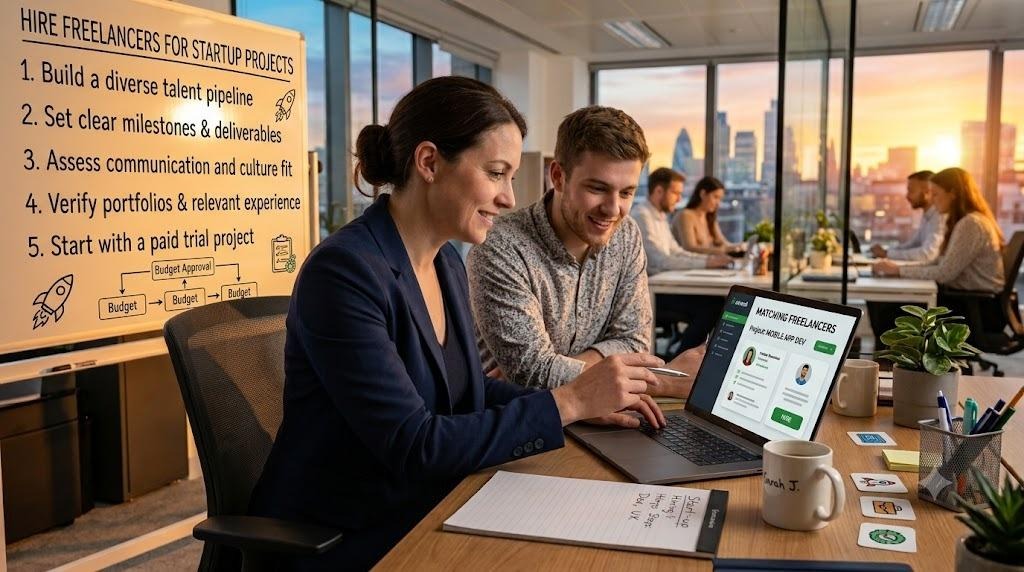
6. Start Small and Use Milestones
Begin with a small paid task or the first phase of a larger project. This lets you assess quality and working style before you commit more budget.
For bigger projects, break the work into milestones and release payment as each stage is approved. Agree on revision limits, deadlines and ownership of the final work in writing before work begins.
7. Protect Your Intellectual Property
For startups, your code, designs and ideas are often your most valuable assets. Make sure your agreement states clearly that ownership of the work transfers to your company on payment, subject to the terms of your contract and applicable law.
Where sensitive information is involved, consider a non-disclosure agreement and limit access to only the systems the freelancer needs.
How to Manage a Freelance Startup Team
Hiring is only half the job. Once your startup freelancers are on board, a few habits will help them do their best work:
- Share context — explain your product, customers and goals so freelancers can make good decisions on their own.
- Use simple tools — a shared project board, a messaging channel and a central place for files keep everyone aligned.
- Set regular check-ins — short weekly updates catch problems early without slowing work down.
- Give fast, clear feedback — slow responses from your side can stall progress and increase costs.
- Document as you go — keep notes, logins and decisions in one place so knowledge stays with your company.
- Rehire your best performers — freelancers who already know your startup get up to speed much faster on new projects.
As your team grows, having a clear process for coordinating different specialists becomes increasingly important. Our guide on how to manage multiple freelancers on one project covers roles, communication, handoffs and project tracking.
Common Startup Hiring Mistakes to Avoid
Avoid these common mistakes when hiring freelancers for your startup:
- Hiring based on the lowest quote rather than relevant experience and results.
- Starting work without a written scope, timeline or payment terms.
- Leaving intellectual property ownership undefined.
- Giving a freelancer full access to every system when they only need a few.
- Changing direction repeatedly without adjusting the scope or budget.
- Relying on a single freelancer for critical knowledge without any documentation.
Quick Checklist: Hiring Startup Freelancers
- Identify the project that matters most right now.
- Write a clear scope with deliverables and deadlines.
- Research market rates and set a realistic budget range.
- Look for freelancers with startup experience and relevant portfolios.
- Interview shortlisted candidates for skills and communication.
- Start with a small paid task or first milestone.
- Put payment terms, revisions and IP ownership in writing.
- Keep communication regular and documentation up to date.
Frequently Asked Questions
Is it better for a startup to hire freelancers or full-time employees?
It depends on the role and stage. Freelancers suit short-term projects, specialist tasks and uncertain needs. Full-time employees are usually better for core, long-term functions. Many startups use freelancers early on and convert some roles to full-time as their hiring needs become clearer.
How much does it cost to hire freelancers for a startup?
Costs vary by skill, experience, location and project size. Comparing several quotes for the same scope and researching typical market rates will help you set a realistic budget.
How do I protect my startup’s ideas when working with freelancers?
Use a written agreement that transfers ownership of the work to your company, add a non-disclosure agreement where needed and only give freelancers access to the information and systems their work requires.
Can freelancers help build an MVP?
Yes. Many startups build their first product with freelance developers and designers. A clear scope, defined milestones and regular check-ins are essential to keep an MVP on time and on budget.
How do I keep a freelance startup team aligned?
Share your goals and context, use a simple project management tool, hold short regular check-ins and give feedback quickly. Clear communication matters even more when your team works remotely and part-time.
Conclusion
Freelancers give startups a flexible, cost-conscious way to access the skills they need at every stage of growth. When you prioritize the right projects, define a clear scope, vet candidates carefully and manage the work with simple, consistent habits, you can hire freelancers for startup projects with confidence and keep your business moving forward.
Ready to build your team? Visit TalentTasker to connect with freelancers for your next startup project.